
The war with Iran remains highly tumultuous despite April’s indefinite ceasefire extension. The truce has been critically strained by a continuous “dual blockade” in the Persian Gulf and direct military flare-ups, with U.S. retaliatory strikes in early June. With geopolitical developments as a top investing concern for 73% of respondents to a recent Schwab survey, investors remain wary of the conflict’s market impact, despite the administration’s reports that a potential peace agreement is in the works.
Equity markets tumbled after a positive May jobs report recontextualized the macroeconomic environment and brought concerns over elevated inflation into the spotlight. Expectations for lower interest rates have reversed as markets price in rate hikes, and investors continue to take profits as higher borrowing costs will likely force decelerated expansion of high-growth companies, namely those in the AI-heavy semiconductor sector.
The new Federal Reserve Chairman, Kevin Warsh, will lead his first FOMC meeting in June. Warsh has long advocated for lower interest rates and has previously critiqued the Fed’s reliance on inflation metrics such as CPI and PCE to inform monetary policy decisions. However, his term begins at a possible inflection point, as Fed governors respond to positive labor market performance juxtaposed with soaring inflation rates and surging treasury yields.
Let’s get into the data:
- Non-farm payrolls rose by 172,000. According to the U.S. Bureau of Labor Statistics (BLS), May overwhelmingly outperformed the Dow Jones estimated increase of 80,000 jobs. The national unemployment rate of 4.3% remained unchanged.
- Headline CPI increased 4.2% year-over-year. This is the first time in three years that inflation has surpassed 4%, although the reading was in line with expectations.
- CME FedWatch data has priced in at least one quarter-point rate hike by October. Investors had previously been hopeful for a rate cut, but rising inflation may reverse the Fed’s presumed course.
- Underlying economic expansion remains. The Atlanta Fed’s GDPNow model tracked Q2 real GDP growth right at 3.7% during its early May updates following the slow 1.2% Q1 GDP print.
What Does the Data Add Up To?
While GDP expectations have bounced back and consumers continue to spend, the primary concern is caused by how they do so. Households are actively dipping into personal reserves. The personal savings rate plummeted to 2.6%, marking its lowest point since 2022. Retail CEOs have warned that persistently high fuel prices and food inflation will soon force a structural shift in consumer behavior
The labor market presents another cause for concern. While the monthly nonfarm payroll numbers have stabilized, the sharp steepening of inflation means real wage growth is failing to keep pace with the rising cost of living. Because inflation remains on an upward trajectory, market expectations for the path of interest rates have adjusted drastically: many economists now project that interest rates will likely not fall again until 2027.
The Fed is working diligently to correct its post-COVID policy missteps, aiming to anchor long-term inflation back down to its 2% target. However, with fresh structural shocks hitting the system—including trade tariffs and regional warfare choking off energy supply chains—concerns of a prolonged inflationary cycle are rising.
For now, regional Fed leaders are preaching caution rather than panic. San Francisco Fed President Mary Daly noted that while energy and fuel oil shocks (up 54.3% year-over-year) are highly concerning, core goods and broader import prices have not yet bled into systemic, worst-case territory. The primary threat remains the Strait of Hormuz; the longer the regional shipping vulnerabilities persist, the higher the risk of severe downstream supply chain disruptions.
All eyes are fixed on the new Federal Reserve Chairman, Kevin Warsh, ahead of the upcoming June Federal Open Market Committee (FOMC) meeting. While interest rates are widely expected to remain unchanged, Warsh’s inaugural press conference will be heavily parsed by Wall Street to gauge his communication style and monetary policy leanings.
Chart of the Month: Labor Market
Despite fears of stagnated hiring, the labor market stabilized over the past three months.
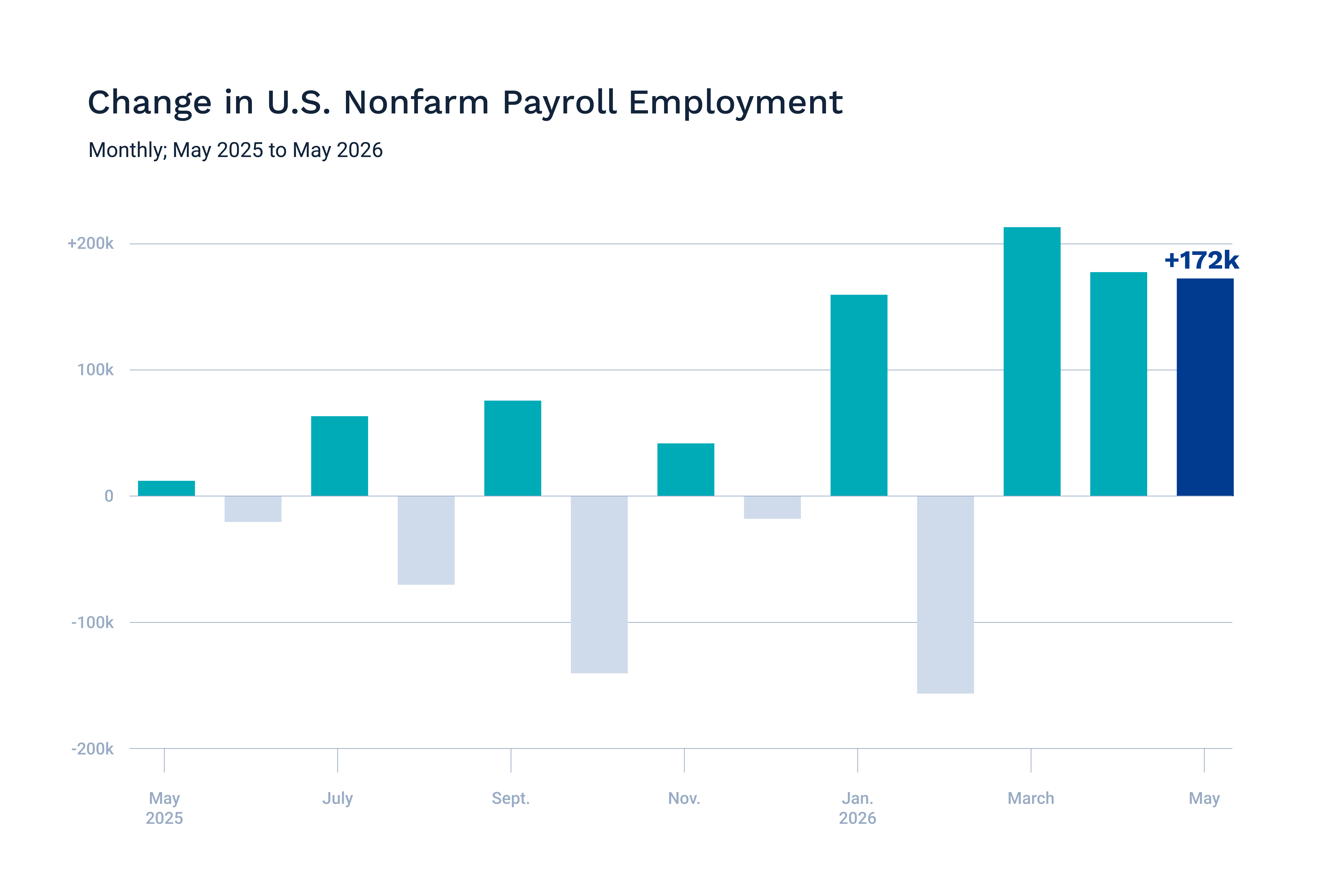
Source: Axios/Bureau of Labor Statistics
Equity Markets in May
- S&P 500: Rose 0.22%, ended the month at 7,580.06
- Nasdaq Composite: Ended the month at 26,972.62, up 0.2%.
- Dow Jones Industrial Average: Finished the month at 51,032.46, up 0.72%.
Bond Markets in May
- 10-Year U.S. Treasury Yield: Ended the month at 4.39%, climbing up from 4.30%.
- 30-Year U.S. Treasury Yield: Rose to 4.98%, up from 4.88%.
- Bloomberg U.S. Aggregate Bond Index: Managed a flat, bare-minimum positive return of 0.1%.
- Bloomberg Municipal Bond Index: Provided a bright spot for fixed-income investors, gaining 1.15%.
The Smart Investor
This macroeconomic backdrop beats summer heat: higher gas prices, elevated headline inflation, and zero near-term relief on borrowing costs. To enjoy the season without derailing long-term financial goals, wealth management should focus on two distinct pillars: strategic cash flow planning and portfolio rebalancing.
While budgeting tracks your day-to-day expenses, cash flow planning is a macro-level, forward-looking strategy. It assesses all income inflows against systemic outflows, intentionally directing capital toward high-yield savings or aggressive debt reduction to offset high interest rates.
Between a gridlocked war, a brand-new Fed chair, and inflation sticking around like an uninvited guest, the markets are giving everyone whiplash right now. It is completely normal if looking at your portfolio makes you sweat a little more than the summer weather.
You don’t have to white-knuckle these market bumps alone Get the peace of mind you deserve with your investments. If you need help adjusting your game plan, we’re right here to help you sort it out.
This work is powered by Advisor I/O under the Terms of Service and may be a derivative of the original.
The information contained herein is intended to be used for educational purposes only and is not exhaustive. Diversification and/or any strategy that may be discussed does not guarantee against investment losses but are intended to help manage risk and return. If applicable, historical discussions and/or opinions are not predictive of future events. The content is presented in good faith and has been drawn from sources believed to be reliable. The content is not intended to be legal, tax or financial advice. Please consult a legal, tax or financial professional for information specific to your individual situation.
This content not reviewed by FINRA
Stay In Touch