
As the conflict between the U.S. and Iran wages on, its impact on oil prices proves continuously relevant to market volatility and the future for inflation. July saw the U.S. reimpose a naval blockade on Iranian ports and resume strikes on Iranian missile and drone sites near the Strait of Hormuz, a waterway that carries a large share of the world’s oil. Iran responded with attacks on shipping in the Gulf, and the hostility continued through the second half of the month.
The result is a continued oil supply disruption that sent prices surging. WTI Crude rose 21% for the month of July, from around $70 a barrel to as high as $93, before coming down to about $84 per barrel on July 27. U.S. crude oil inventories measured 404.5 million barrels for the week ending July 24 according to the U.S. Energy Information Administration’s weekly petroleum status report, though this count excludes the Strategic Petroleum Reserve, an emergency stockpile maintained by the Department of Energy. Commercial crude inventories shed 7.2 million barrels from the previous week, hitting levels 7% below the five-year seasonal average.
The FOMC held the federal funds rate at 3.50%-3.75% at its July 29 meeting, but long-term treasury yields jumped to record highs as the Fed’s inaction led investors to price in the possibility of ongoing elevated inflation. The 10-year Treasury yield pushed to its highest level since January 2025, while the 30-year Treasury yield reached its highest since July 2007. Equities slipped after the Fed’s decision, but rallied after second-quarter earnings reports brought on renewed optimism regarding AI spending.
Let’s get into the data:
- Interest rate futures indicate a September hike is likely. CME’s FedWatch tool reported the probability of a quarter-point hike at the September meeting as 67.2% on August 3.
- Consumers reported lower year-ahead inflation expectations in July. University of Michigan’s Survey of Consumers showed an expected 4.2% change in prices for the year ahead, down from the 4.6% year-ahead inflation prediction in June.
- Headline CPI is projected to decline. As of August 3, the Federal Reserve Bank of Cleveland’s Inflation Nowcasting tool forecasts annualized headline CPI to come in at 3.42% in July, down slightly from June’s 3.5% reading.
What Does the Data Add Up To?
The Fed’s decision to hold in July stoked investor fears of higher-for-longer inflation, prompting the Treasury selloff that drove up yields despite unchanged interest rates. In the official FOMC statement, the Committee attributes elevated inflation to supply shocks in the energy sector that pushed prices higher, and highlights growing economic activity and minimal change to the unemployment rate as indicators of an otherwise healthy economy.
3 of the 12 voting FOMC members dissented in favor of raising the federal funds rate to 3.75%-4.00%, indicating that the Committee may be poised for a more hawkish decision in September. Both consumers and Federal Reserve economists forecast inflation cooling in July; however, their respective projections of 4.2% and 3.42% still exceed the Fed’s inflation target of 2%. The surge in oil prices appears to have a significant impact on consumer year-ahead inflation expectations, which have risen each month of the U.S.-Iran war from 3.4% in February 2026.
The Federal Open Market Committee acknowledged that inflation remains above their 2% target in its July meeting statement, but aside from a promise to deliver price stability, the Committee’s approach to elevated inflation is left unaddressed. This is in line with Chairman Warsh’s preference for minimal forward guidance and may reflect that Fed governors are waiting for July inflation readings before determining the road ahead for monetary policy.
Chart of the Month: Crude Oil Prices Remained Tumultuous in July
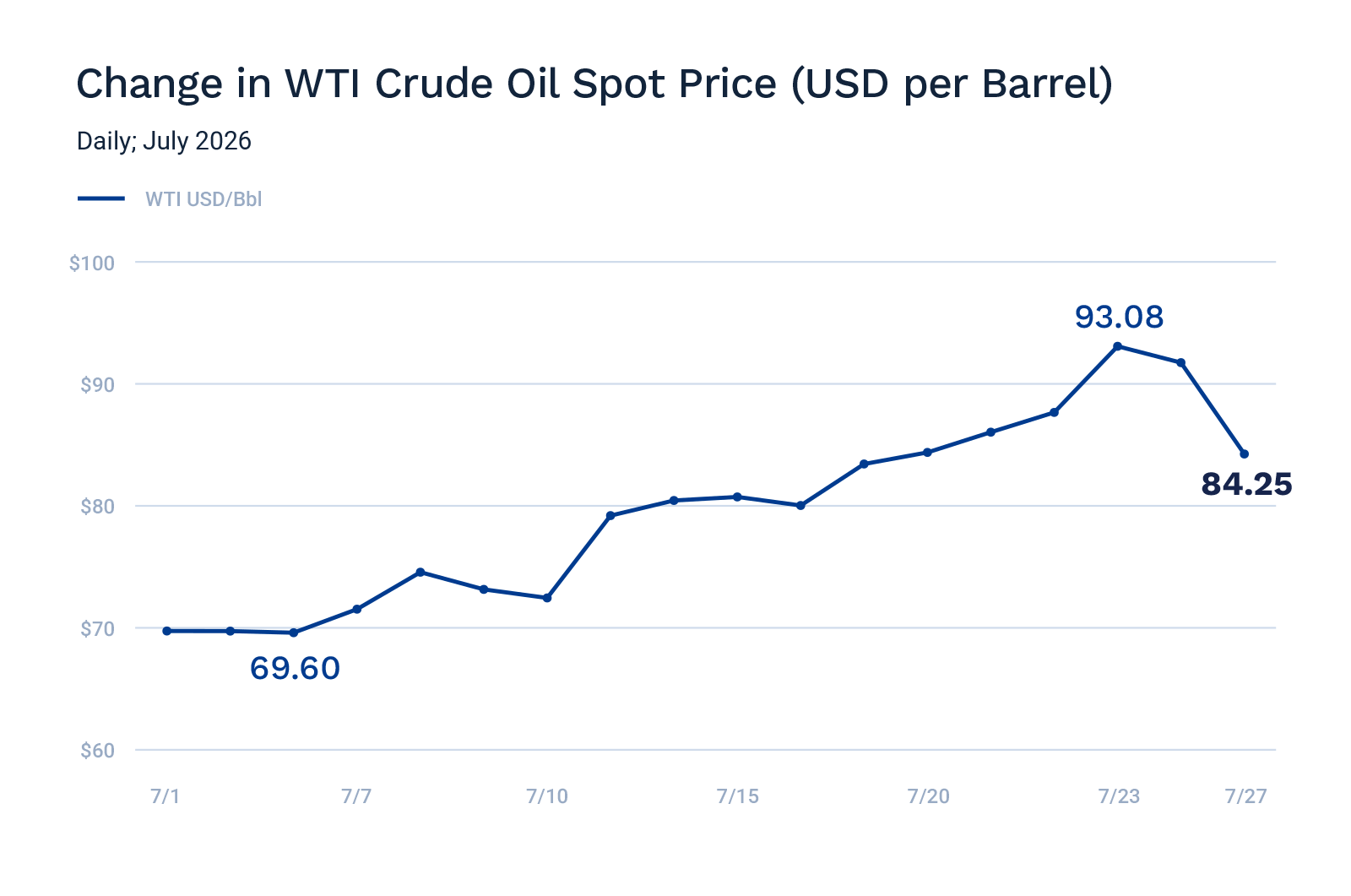
Source: Federal Reserve Bank of St. Louis via FRED (DCOILWTICO)
Though crude oil prices surged in July, the price per barrel cooled in the last week of the month as tanker traffic through Hormuz began to recover. However, the U.S.-Iran war has demonstrated underlying persistence even as tension waxes and wanes, and consequently, a clear timeline for the stabilization of oil prices remains to be seen.
Equity Markets in July
- The S&P 500 gained 0.7% on the month, closing at 7,489.72.
- The Nasdaq Composite declined -1.7% after major tech sector selloffs, ending the month at 25,373.85.
- The Dow Jones Industrial Average rose 0.58% to close at 52,485.03.
Bond Markets in July
- The 10-Year U.S. Treasury Yield ended the month at 4.75%, hitting its highest level since January 2025.
- The 30-Year U.S. Treasury Yield closed at 5.28%, its highest level since July 2007.
- The 2-Year U.S. Treasury Yield closed at 4.29%, indicating selloffs also occurred for short-term treasuries.
The Smart Investor
Volatility in July was shaped not only by geopolitical conflict, but also by monetary policy, investor sentiment, and in some cases, subverted expectations. It’s a useful reminder that investing isn’t about avoiding disruption, but instead weathering the storm. A diversified portfolio can help you stay resilient through periods of volatility. If you need help navigating the path forward, we’re always here to answer your questions and provide support.
This work is powered by Advisor I/O under the Terms of Service and may be a derivative of the original.
The information contained herein is intended to be used for educational purposes only and is not exhaustive. Diversification and/or any strategy that may be discussed does not guarantee against investment losses but are intended to help manage risk and return. If applicable, historical discussions and/or opinions are not predictive of future events. The content is presented in good faith and has been drawn from sources believed to be reliable. The content is not intended to be legal, tax or financial advice. Please consult a legal, tax or financial professional for information specific to your individual situation.
This content not reviewed by FINRA
Stay In Touch