
The U.S.-Iran ceasefire that helped calm markets in the spring has proven fragile. Hostilities flared again in late June and into July, and while a full return to open conflict has been avoided so far, the on-again, off-again nature of the truce continues to keep markets on edge. Even so, June’s economic data brought a welcome, if complicated, surprise: inflation came in well below expectation, falling 0.4% on the month, which marks the largest monthly decline in headline inflation since April 2020.
New Federal Reserve Chairman Kevin Warsh led his first FOMC meeting in June, holding rates steady at 3.50%–3.75%, in line with expectations. The June CPI reading indicates that there may be less pressure on the Fed to raise rates, especially given that hiring figures for the month came in under expectation. However, interest rate futures show predictions for a hawkish Fed in the second half of 2026, with rate hike probabilities hovering around 50% for the FOMC’s September meeting. Moreover, in contrast with the Fed’s traditional forward guidance, Chairman Warsh has expressed a preference for shorter, less transparent policy statements, keeping investors on their toes as the July meeting draws nearer.
The Dow Jones Industrial Average pushed to record highs in the first half of the year, while the S&P 500 and Nasdaq Composite each fell on the month, as elevated valuations in AI and semiconductor stocks came under renewed scrutiny. Treasury yields were volatile, but ended the month little changed.
Let’s get into the data:
- Nonfarm payrolls grew by 57,000 jobs, less than half the 115,000 expected. The June jobs report marks the smallest monthly employment increase in four months, even after job gains in April and May were revised down by 31,000 and 43,000 respectively. Unemployment ticked down to 4.2%, though this was likely due to a decline of 0.3% in labor force participation.
- Headline CPI came in at 3.5% year over year, down sharply from May’s 4.2%. This is the first inflation cooldown in five months, and the largest one-month decline since April 2020, with the index falling 0.4% in June. The greatest contributing factor was the 5.7% decline in energy costs, which came down for the first time since January. Core CPI, which excludes volatile food and energy sectors, was unchanged for the month.
- Estimated real GDP growth in Q2 has pulled back significantly. As domestic investment growth softens, the Atlanta Fed’s GDPNow model estimate has dropped to 1.2% as of July 1, down from readings around 3% in early June.
What Does the Data Add Up To?
June’s CPI report is best read as relief, not resolution. The drop in inflation came almost entirely from an energy price reversal tied to the temporary calm in the Middle East, and that calm didn’t last: fighting between the U.S. and Iran resumed in the days that followed, and oil prices have already started climbing back. Economists have flagged May, not June, as this year’s likely inflation peak, but it will likely depend on how markets react as the conflict evolves.
The labor market data tells a similarly complicated story. Lower unemployment would normally be read as constructive; however, the 0.3% decline in labor force participation is more likely the driver behind the marginal improvement rather than stronger demand for workers. Leisure and hospitality notably shed 61,000 jobs in June, indicating weaker than usual seasonal hiring, even with a boost from World Cup-related activity. Combine that with a softening Q2 GDP estimate, and the outlook for the economy starts to feel negative.
However, it’s not all bad news. June’s economic data also tells a story of a potential underlying trend of cooling inflation. While the majority of headline CPI’s deceleration can be attributed to falling energy costs, core CPI cooled as well. The index for all items less food and energy was flat on the month and rose only 2.6% over the 12 months ending in June, down from 2.9% in May. The index for services less energy also came in flat for June, and the index for commodities less food and energy fell 0.1%.
The drop in energy prices may prove temporary as the conflict in Iran evolves, but a certain degree of price volatility in the energy sector is anticipated and accounted for. Core CPI sheds light on economic sectors whose costs are less affected by specific global events, potentially providing better insight on broader inflation trends. The June CPI reading suggests that fluctuating energy costs have had a measurable impact on inflation over the last several months, and that prices otherwise appear to be trending downward. This provides a cautiously optimistic outlook for inflation, as well as for interest rates, since the Fed will likely feel less inclined to hike rates amid declining inflation.
Chart of the Month: Oil Prices Came Down, But Volatility Persists
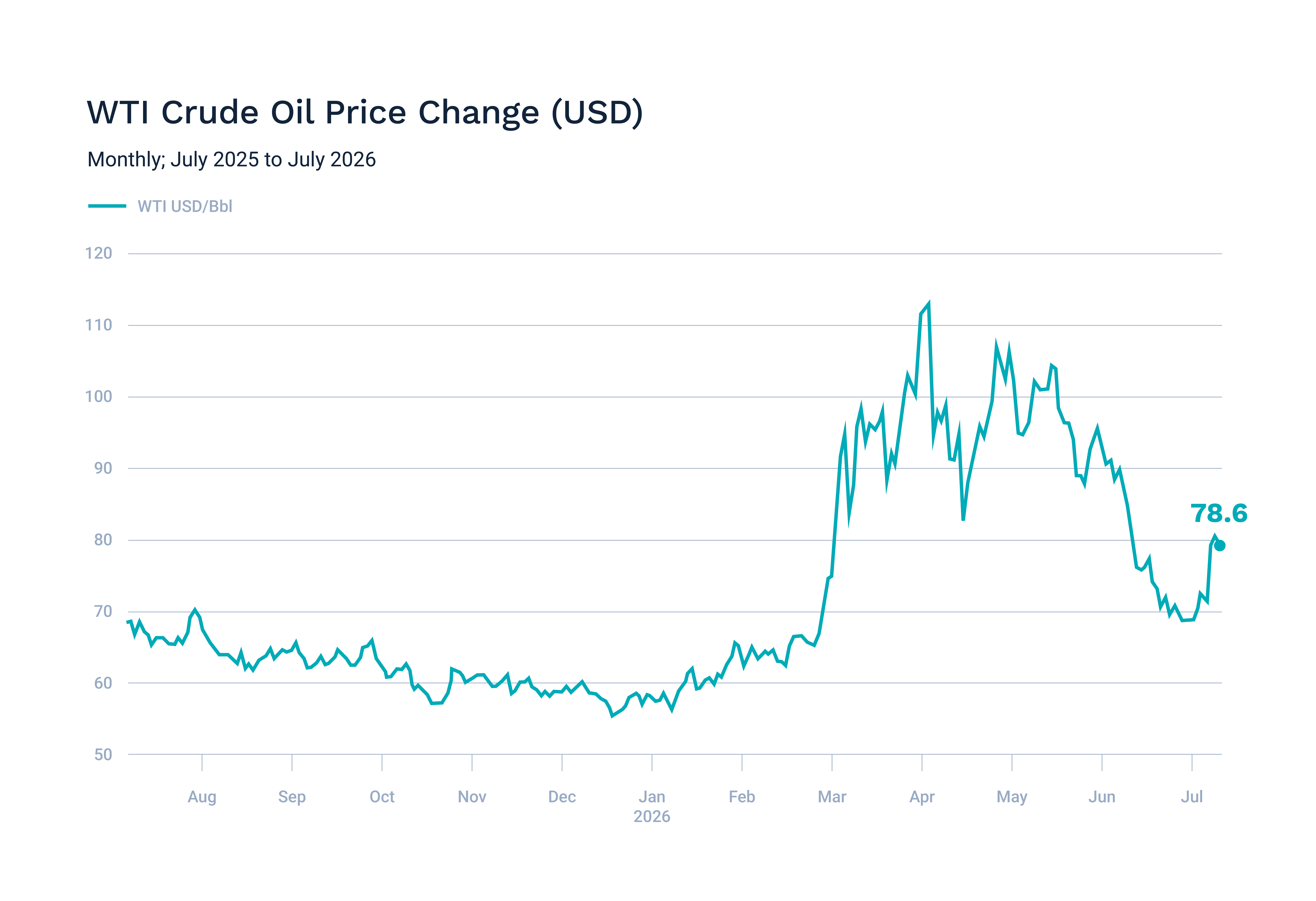
Source: Trading Economics
Equity Markets in June
- The S&P 500 fell 1.1%, ending the month at 7,499.36, marking its first down month since March.
- The Nasdaq Composite declined 2.9% to end the month at 26,213.72, as AI and semiconductor valuations came under pressure.
- The Dow Jones Industrial Average rose 2.5% to close at a record 52,319.20, aided by a rotation into value and small-cap names.
Bond Markets in June
- The 10-Year U.S. Treasury Yield ended the month at 4.42%, after trading as high as 4.69% earlier in the quarter.
- The 30-Year U.S. Treasury Yield eased to 4.90%, down from 4.99% in May.
- The Bloomberg U.S. Aggregate Bond Index returned 0.31% for the month as yields pulled back from their spring peak.
The Smart Investor
If June taught us anything, it’s that “good news” and “all clear” aren’t the same thing right now. Inflation cooled, but for reasons that may not hold. Hiring was not as robust as expected, but layoffs haven’t spiked. The Fed held steady, but its new chair is deliberately giving less guidance than markets are used to.
Between the resumed conflict overseas, a new era for the FOMC, and an uncertain outlook for economic growth, there’s a lot at play when it comes to considering how best to position your finances for the road ahead. It starts with building your portfolio to be resilient through periods of volatility rather than planning for a specific forecast. If you need help adjusting your game plan, we’re right here to help you sort it out.
This work is powered by Advisor I/O under the Terms of Service and may be a derivative of the original.
The information contained herein is intended to be used for educational purposes only and is not exhaustive. Diversification and/or any strategy that may be discussed does not guarantee against investment losses but are intended to help manage risk and return. If applicable, historical discussions and/or opinions are not predictive of future events. The content is presented in good faith and has been drawn from sources believed to be reliable. The content is not intended to be legal, tax or financial advice. Please consult a legal, tax or financial professional for information specific to your individual situation.
This content not reviewed by FINRA
Stay In Touch